

IFRS 16 and the Right-of-Use Asset: What Your Car Lease Really Looks Like on the Balance Sheet
Under IFRS 16, that five-year car lease isn't rent — it's an asset and a liability from day one. A practical walkthrough for finance professionals: initial recognition, monthly entries, the 3-year vs 8-year depreciation debate, title transfer, and the disclosures auditors expect.
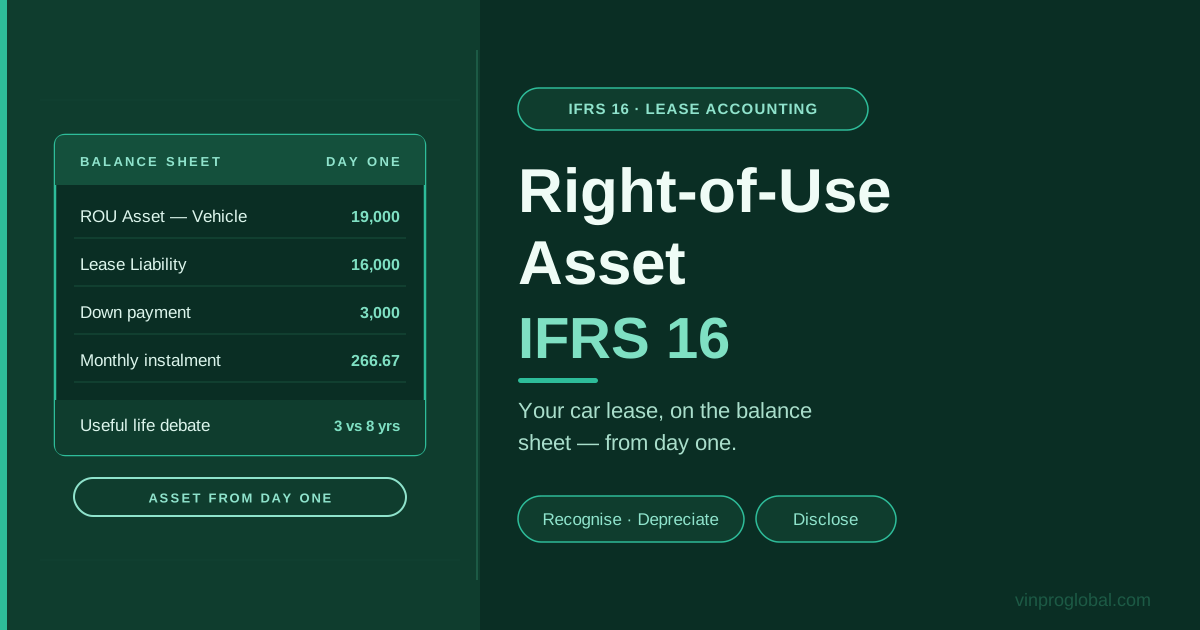
When a business rents a car from a dealer for five years, pays a lump-sum upfront, and clears the balance through monthly instalments — most people instinctively think “rental expense.” Under IFRS 16, that instinct is wrong. That car is on your balance sheet from day one. Here is what that means, step by step.
Initial Recognition: Day One
On the commencement date, two amounts are recognised simultaneously.
Lease Liability
The lease liability equals the present value of future lease payments. At a 0% implicit rate:
Lease Liability = 60 × 266.67 = 16,000
If there were an embedded interest rate, you would discount those payments using the rate implicit in the lease or, if not readily determinable, the lessee's incremental borrowing rate.
Right-of-Use Asset
Per IFRS 16.24, the ROU asset is measured at:
| Component | Amount |
|---|---|
| Lease liability at initial recognition | 16,000 |
| Lease payments made at or before commencement (down payment) | 3,000 |
| Initial direct costs incurred | — |
| Dismantling cost provision (if applicable) | — |
| ROU Asset — total | 19,000 |
The down payment is not an expense and not a prepayment. It is a lease payment made at commencement, which IFRS 16.24(b) specifically includes in the cost of the ROU asset.
Journal Entry — Day One
Dr  Right-of-Use Asset – Vehicle        19,000
      Cr  Lease Liability                       16,000
      Cr  Cash / Bank (down payment)             3,000
The balance sheet immediately shows:
- Asset: ROU Asset 19,000 (non-current)
- Liability: Lease Liability 16,000 (split: ~3,200 current, ~12,800 non-current)
Subsequent Measurement: Every Month
Lease Liability — Amortised Cost
At a 0% implicit rate, every monthly payment is entirely principal. The liability reduces by 266.67 each month with no interest charge.
Dr  Lease Liability           266.67
      Cr  Cash / Bank                 266.67
If the implicit rate were above 0%, each payment would be split between interest (Dr Finance Costs) and principal (Dr Lease Liability) using the effective interest method. The finance cost would appear in the P&L, not as part of the principal repayment.
ROU Asset — Depreciation
Here is where IFRS 16.31 introduces a nuance that many practitioners miss:
“If the lease transfers ownership of the underlying asset to the lessee by the end of the lease term… the lessee shall depreciate the right-of-use asset from the commencement date to the end of the useful life of the underlying asset.”
Since ownership transfers here, depreciation is over the useful life of the car, not over the five-year lease term. Using a 5-year useful life assumption:
Annual depreciation   = 19,000 ÷ 5    = 3,800
Monthly depreciation  = 19,000 ÷ 60   = 316.67

Dr  Depreciation Expense              316.67
      Cr  Accumulated Depreciation – ROU  316.67
Illustrative Schedule (first three months + month 60)
| Period | Opening Liability | EMI Paid | Interest | Principal | Closing Liability | Monthly Dep | ROU NBV |
|---|---|---|---|---|---|---|---|
| Day 1 | — | 3,000.00 | — | 3,000.00 | 16,000.00 | — | 19,000.00 |
| Month 1 | 16,000.00 | 266.67 | — | 266.67 | 15,733.33 | 316.67 | 18,683.33 |
| Month 2 | 15,733.33 | 266.67 | — | 266.67 | 15,466.67 | 316.67 | 18,366.67 |
| Month 3 | 15,466.67 | 266.67 | — | 266.67 | 15,200.00 | 316.67 | 18,050.00 |
| ··· | ··· | ··· | ··· | ··· | ··· | ··· | ··· |
| Month 60 ★ | 266.67 | 266.67 | — | 266.67 | — | 316.67 | — |
★ Month 60 = ownership transfer. Lease liability fully settled.
Balance Sheet and P&L Impact
What changed versus the old operating lease treatment?
| Item | Old IAS 17 (Operating Lease) | IFRS 16 (ROU Model) |
|---|---|---|
| Monthly P&L charge | Rent expense: 266.67 | Depreciation: 316.67 |
| Finance cost in P&L | Nil | Nil (at 0% rate) |
| Liability on balance sheet | Nil | 16,000 (reducing) |
| Asset on balance sheet | Nil | 19,000 (net of dep.) |
| EBITDA impact | Lower (rent above EBITDA line) | Higher (dep. below EBITDA) |
EBITDA is higher under IFRS 16 because depreciation sits below the EBITDA line, whereas rent used to sit above it. This is the structural shift IFRS 16 created for balance sheet-heavy businesses — and why leveraged ratios and debt covenants need revisiting when you adopt the standard.
The Depreciation Assumption Debate: 3 Years vs. 8 Years
Now comes the question that genuinely matters for practitioners: what useful life do you assign to the car?
IFRS 16.31 says depreciate over the useful life of the underlying asset. IAS 16.56 defines useful life as “the period over which an asset is expected to be available for use by the entity.” This is a management judgement — and it has a significant P&L impact.
Key Numbers at a Glance
| 8-Year Useful Life | 3-Year Useful Life | |
|---|---|---|
| Annual depreciation | 2,375 | 6,333 |
| Monthly depreciation | 197.92 | 527.78 |
| NBV at ownership transfer (end yr 5) | 7,125 | NIL |
| Depreciation after transfer | 3 more years in PPE | None — fully written off |
| Total write-off period | 8 years | 3 years |
The 8-Year Assumption
- Lower annual P&L charge (2,375/year)
- Asset still carries a book value of 7,125 at the point ownership transfers
- Depreciation continues for three years post-transfer, reclassified from ROU Asset to PPE
- Better reported EBITDA and net profit in years 1–3
- Higher total asset base on the balance sheet throughout the lease
Appropriate for: low-mileage executive car, company director's vehicle, moderately used commercial vehicle.
The 3-Year Assumption
- Heavy front-loading: 6,333/year hits P&L in years 1–3 only
- Asset is fully written off by year 3, with NIL book value for the remaining 2 years of the lease
- Zero depreciation in years 4 and 5, even though the car is still generating economic benefit
- Creates a mismatch: the lease liability continues amortising over all 60 months while the asset disappears from the books after 36
Appropriate for: high-mileage fleet vehicle, rapid obsolescence use case (technology-embedded cars), where the entity's documented replacement policy is ≤ 3 years.
Which Assumption Is More Defensible?
For most commercial car arrangements, 8 years (or at minimum 5–6 years) is the more defensible estimate. Here is why:
- Ownership transfers at end of year 5, meaning the entity expects to continue deriving economic benefit beyond the lease — implying a useful life longer than the lease term
- Industry norm for passenger and light commercial vehicles is 5–10 years under most accounting frameworks globally
- A 3-year useful life requires affirmative evidence: documented high annual mileage, manufacturer lifecycle data showing economic life ≤ 3 years, or a formal fleet replacement policy capping use at 3 years
- Auditor scrutiny: if you apply a 3-year life and the car is manifestly still in productive use in years 4 and 5 with a zero book value, auditors will raise this as a management estimate issue. IAS 36 provides no mechanism to write the asset back up — the damage is in prior-year retained earnings
What If You Need to Change the Estimate Mid-Lease?
A revision to useful life mid-lease is treated as a change in accounting estimate under IAS 8.32. The treatment is prospective — you do not restate prior periods. Apply the revised depreciation rate from the period of change and disclose the nature and financial effect in the notes.
End of Lease: What Happens When Title Transfers?
At month 60, the lease liability hits zero (fully settled). The ROU asset is either fully depreciated or, under the 8-year assumption, carries a residual book value of 7,125.
No additional “purchase” journal entry is needed — the car was already recognised as an asset from day one. The only entry required is a reclassification from ROU Asset to PPE (if your entity's policy distinguishes between the two):
Dr  PPE – Vehicle                        [NBV of ROU Asset]
      Cr  Right-of-Use Asset – Vehicle       [Gross cost]

Dr  Accumulated Depreciation – ROU Asset  [Accumulated dep]
      Cr  Accumulated Depreciation – PPE     [Same]
Under the 8-year assumption, the asset then continues to depreciate at 2,375/year for the remaining three years in the PPE schedule.
Required IFRS 16 Disclosures — A Checklist
The standard (IFRS 16.47–60) requires entities to disclose:
- ROU assets by class (additions, depreciation, closing NBV)
- Lease liabilities — maturity analysis (< 1 year, 1–5 years, > 5 years)
- Total cash outflow for leases in the period
- Interest expense on lease liabilities
- Depreciation charge on ROU assets
- Short-term and low-value lease expense (if any exemptions are used)
- Significant judgements — including useful life estimates for assets where ownership transfers
That last point is material when you are making the 3-year vs. 8-year call: document your reasoning in the accounting policy note, not just in an internal working paper.
— Prepared by Raghavendran T, Vinpro Global.